



How Strategic Branding Builds Long-Term MSME Sustainability
The backbone of India’s economy—Micro, Small and Medium Enterprises (MSMEs)—faces an alarming challenge. While MSMEs contributed nearly 8% of India’s total GDP and 45% of manufacturing output in 2021, approximately 96% of MSMEs have closed in the last three years. This stark reality underscores a critical gap in how these businesses approach growth and longevity. The solution lies not in complex strategies or massive capital investments, but in something far more fundamental: strategic branding.
For MSMEs operating across India’s Tier-2 and Tier-3 cities, from manufacturing hubs to service-based enterprises, branding is often dismissed as a luxury reserved for large corporations. This misconception is precisely why many businesses struggle to survive beyond their initial growth phase. Strategic branding, when executed thoughtfully, becomes the differentiator that transforms a struggling MSME into a sustainable, thriving enterprise.
Understanding Strategic Branding for MSMEs
Strategic branding transcends the traditional understanding of logos, color schemes, and catchy taglines. It encompasses the entire identity and perception your MSME creates in the minds of customers, stakeholders, and the market. For MSMEs, branding is the first meaningful interaction customers have with your business—it’s the promise you make and the consistency with which you deliver on that promise.
The essence of strategic branding lies in its ability to communicate trust, quality, and reliability. When executed well, a strong brand reduces the perceived risk for customers, allowing them to choose your MSME over cheaper alternatives. This advantage becomes the foundation for sustainable, long-term growth.
Why Long-Term Brand Building Trumps Short-Term Marketing
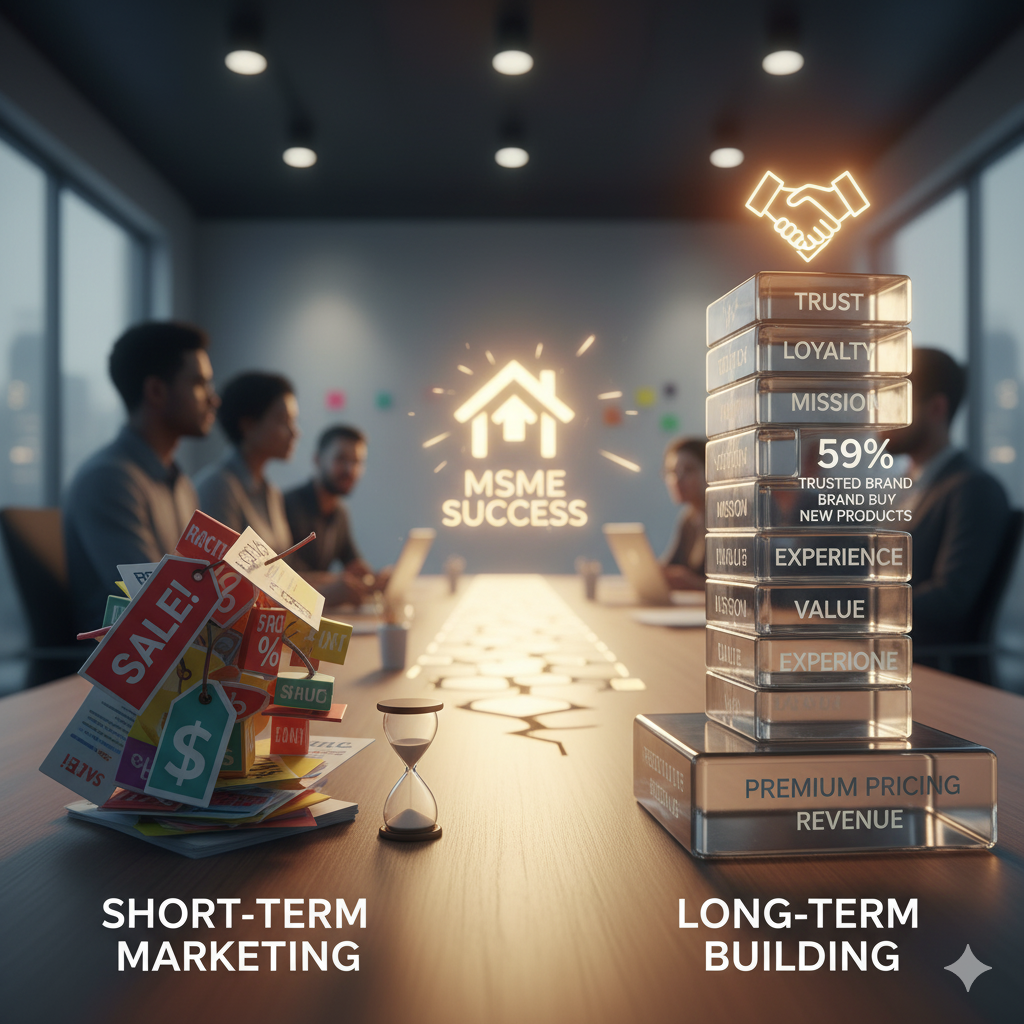
MSMEs often find themselves caught between the temptation of quick wins through promotional campaigns and the patience required for genuine brand building. Short-term marketing strategies might deliver temporary spikes in sales, but they lack the depth required for sustainable success. A customer attracted by a heavy discount today may abandon you tomorrow for a cheaper competitor.
In contrast, long-term brand building creates enduring customer relationships. When a customer identifies with your brand’s values, mission, and the experience you provide, they become more than transactional—they become advocates. Research shows that 59% of consumers are more likely to buy new products from a brand they trust, even if it’s not the cheapest option. This loyalty translates directly into stable, predictable revenue streams essential for MSME sustainability.
Long-term branding also facilitates premium pricing. A well-established brand commanding customer loyalty can justify higher prices, directly improving profit margins. This financial resilience is what allows MSMEs to weather market downturns, invest in innovation, and expand operations systematically.
The Four Pillars of Strategic MSME Branding
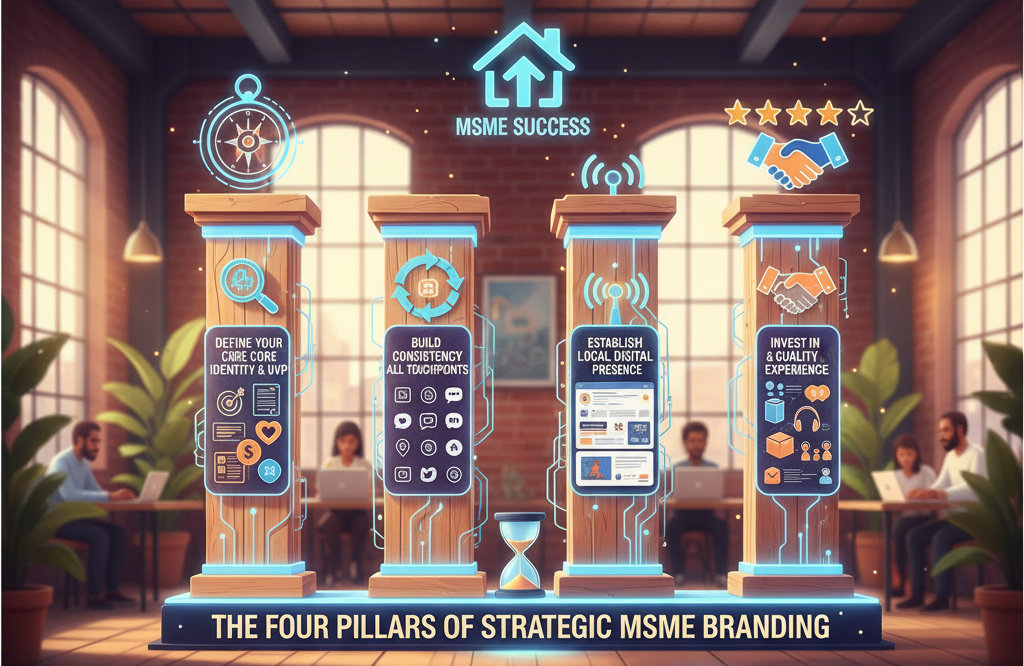
1. Define Your Core Identity and Unique Value Proposition
Before any branding effort, MSMEs must engage in rigorous self-analysis. What problems does your business solve? What makes you fundamentally different from competitors? This clarity forms the foundation of all branding efforts.
For a manufacturing MSME in Delhi, this might mean specializing in eco-friendly packaging solutions. For a service-based business in Bangalore, it could be emphasizing hyper-local, personalized customer support. The specificity matters because it guides every subsequent branding decision and attracts the right customer base.
2. Build Consistency Across All Touchpoints
Consistency is the glue that holds brand identity together. Whether customers interact with your MSME through your website, social media, packaging, or in-person service, they should encounter the same brand voice, values, and visual identity. This consistency builds recognition and trust over time.
For resource-constrained MSMEs, this doesn’t require expensive agency support. Using free design tools and maintaining simple brand guidelines ensures that even when delegating tasks to team members, brand consistency remains intact.
3. Establish Local Digital Presence
In today’s market, a digital presence is non-negotiable for MSME sustainability. However, the approach must be local-first. Google My Business optimization ensures your MSME appears in local searches—a critical advantage for businesses serving geographic communities. A simple website, purposeful social media presence focused on engagement rather than volume, and local SEO practices make your MSME discoverable to customers actively seeking your services.
For MSMEs in Tier-2 and Tier-3 Indian cities, platforms like WhatsApp Business and Google My Business offer cost-effective channels to build credibility and maintain direct customer relationships without extensive marketing budgets.
4. Invest in Quality and Customer Experience
Strategic branding isn’t just about communication—it’s about delivering on your promises consistently. Every customer interaction, whether through improved packaging, responsive customer service, or product quality, reinforces your brand identity. MSMEs that treat customer experience as a branding investment often find that word-of-mouth marketing becomes their most powerful tool.
Converting Brand Building into Business Resilience
The direct link between strategic branding and MSME sustainability becomes evident when examining business resilience. A well-branded MSME enjoys several competitive advantages:
Lower customer acquisition costs: Established brand recognition means marketing efforts yield better conversion rates. Existing customers require less convincing to try new offerings, reducing the cost per acquisition.
Reduced price competition: Strong brands attract customers willing to pay premium prices based on perceived value, not just cost comparison. This pricing power improves profitability.
Easier market expansion: When expanding to new geographic markets or launching new products, an established brand provides credibility that new entrants lack. This accelerates growth while reducing market entry risks.
Stakeholder confidence: Investors, lenders, and potential business partners are more confident in branded businesses. This facilitates access to capital, partnerships, and growth opportunities essential for scaling.
Practical Steps for MSME Branding on a Limited Budget
Strategic branding doesn’t demand large-scale advertising spends. MSMEs can build powerful brands through:
- Defining a clear brand name, logo, and visual identity using free design tools
- Creating consistent messaging around your unique value proposition
- Leveraging local influencer collaborations and user-generated content
- Optimizing packaging as a branding tool
- Establishing a simple, SEO-optimized web presence
- Using cost-effective social media strategies focused on genuine engagement
Conclusion
For MSMEs across India, strategic branding represents the difference between becoming part of the 96% that close within three years and joining the thriving businesses that scale sustainably. Long-term branding builds the customer loyalty, premium pricing power, and market credibility that allow businesses to weather uncertainties and capitalize on opportunities.
The investment required isn’t primarily financial—it’s intellectual and consistent. By clearly defining their identity, maintaining consistency across touchpoints, building a local digital presence, and genuinely delivering on brand promises, MSMEs can construct the foundation for sustainable, long-term success. In a competitive landscape where customers increasingly choose brands they trust, strategic branding has become not a luxury, but a necessity for MSME sustainability.
