



Introduction
In the dynamic landscape of business development, two prominent categories of enterprises drive economic growth and innovation: startups and Micro, Small, and Medium Enterprises (MSMEs). While both contribute significantly to employment generation and market development, they represent fundamentally different approaches to business building and growth. Understanding the distinctions between these business models is crucial for entrepreneurs, investors, and policymakers, as each faces unique challenges and opportunities in their respective growth journeys.
Growth Philosophy and Market Approach
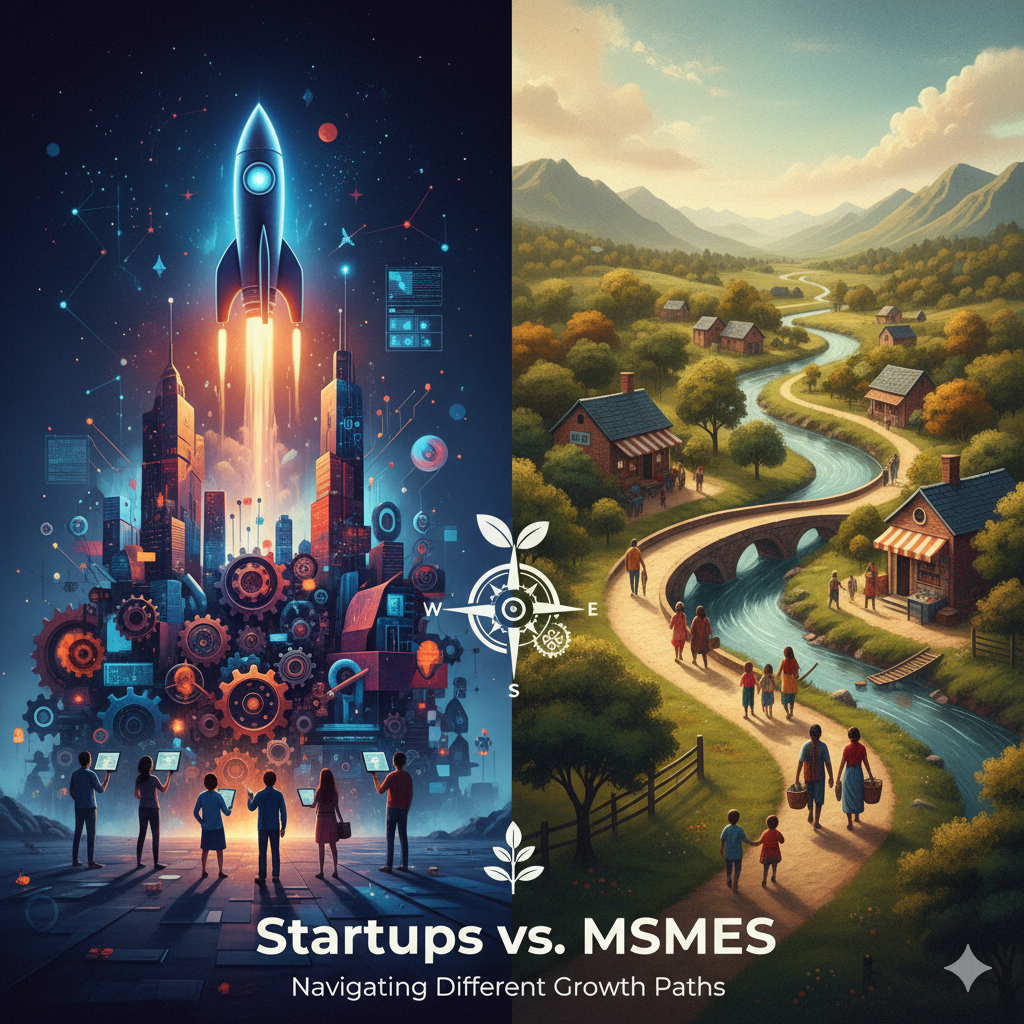
The most fundamental difference between startups and MSMEs lies in their growth philosophy. Startups are designed for exponential growth, seeking to disrupt markets and capture significant market share rapidly through innovative solutions. They prioritize scalability over immediate profitability, often sacrificing short-term gains for long-term market dominance. Conversely, MSMEs focus on steady, sustainable growth within established markets. They emphasize stability, profitability, and incremental expansion, typically serving local or regional markets with proven business models.
Funding Structures and Financial Strategies
The financing approaches of startups and MSMEs reflect their different growth objectives. Startups typically rely on external funding sources such as venture capital, angel investors, and crowdfunding platforms to fuel rapid expansion. This high-risk, high-reward funding model supports ambitious growth plans but requires entrepreneurs to surrender equity and accept intensive investor scrutiny. MSMEs, in contrast, primarily depend on traditional funding sources including bank loans, government schemes, personal savings, and internal cash flow. This approach provides greater control but may limit growth potential due to capital constraints.
Common Growth Challenges
Despite their different approaches, startups and MSMEs face several similar growth challenges. Access to adequate funding remains a critical issue for both categories, with studies showing that 28% of businesses cite raising funds as their top challenge. Competition intensity affects both types of enterprises, with over 25% of surveyed businesses identifying high competition as a major growth obstacle. Additionally, both startups and MSMEs struggle with technology adoption, skilled workforce availability, and market access challenges.
Risk Profiles and Operational Differences

The risk tolerance and operational structures of startups and MSMEs differ significantly. Startups embrace high-risk, high-reward scenarios, operating in uncertain environments with innovative business models that may or may not achieve market acceptance. Their organizational structures tend to be flat and agile, encouraging rapid decision-making and adaptation. MSMEs typically operate with more conservative risk profiles, focusing on proven business models and established markets. Their operational structures are often more traditional and hierarchical, prioritizing stability and consistent service delivery.
Conclusion
While startups and MSMEs both contribute essential value to economic development, their distinct approaches to growth, funding, and market engagement create different sets of challenges and opportunities. Startups offer the potential for rapid scaling and market disruption but face higher failure rates and funding dependencies. MSMEs provide stability and consistent employment generation while facing limitations in scalability and access to growth capital. Understanding these differences enables entrepreneurs to choose the most appropriate path based on their risk tolerance, resource availability, and long-term objectives, while policymakers can develop targeted support programs that address the specific needs of each business category.
